We Bought A Farm…
If you pulled into our gravel driveway tomorrow and asked me what this place is, I'd give you this short answer.
This is a micro farm. We grow microgreens, mushrooms, vegetables, and cut flowers. It's a place for family and the community to come together and for us to support each other.
That's it. That's the whole thing in two sentences.
Behind those two sentences are a couple of years of searching, a property that turned out to be six times the size we set out to buy, and a first month spent relearning from my youth how to work with heavy clay and getting raised garden beds made and planted. So here's the longer version.
The Why Came First
Jeanette and I had been looking for a couple of years before this property showed up. A few things were pulling us out of the city:
We've always lived in the country. We moved into town when the kids were in school because it was easier. Now we want the quiet back, and a more balanced way of living.
We wanted to grow our own food again. Real food security. No pesticides, no herbicides, no GMOs, and not having to depend on a supply chain that keeps getting more fragile every year.
We try to use as little medication as possible and lean on herbs instead. A farm gives us the room to keep going with that and to grow more of what we use.
Self-sufficiency on a wider scale. Maybe solar one day. Less reliance on systems that aren't as sustainable.
A property we can walk on. Our own woods. Our own creek.
Something to leave behind for our kids and any grandkids that come along, a place they can come and enjoy or work on if they want to.
And honestly, the simple lifestyle of being back in the country and the peace that we have been craving.
We Went Looking for Five Acres. We Bought Thirty.
The plan was three to six acres. Enough to do what we wanted, not so much that we couldn't take care of it.
The problem is that those properties barely exist around here. Most of what comes up is 2 or 2.5 acres, residential lots big enough for a decent garden but stacked close to the neighbours.
This one came along priced about like one of those small lots, with the extra land thrown in. 30 acres. A view of a small lake. Close to water without being on it. A boat launch behind the property where we can drop a kayak in.
A few things sealed it:
Woods, a creek, marshy areas, and conservation land all back onto the property. That kind of variety is gold for foraging and for herbalism.
The land has not been sprayed with pesticides or herbicides in over 30 years. The neighbouring properties aren't big agricultural operations either, so there's no spray drift to worry about.
It already had a greenhouse, a small shop near the road, two small barns, and a house that is slightly smaller than our current own, so we can downsize the house but not at a shock level.
It wasn't a love-at-first-sight property. We looked at it more than once. What kept pulling us back was the quiet. You can actually hear the birds. Neighbours are close enough to feel like a community, but not on top of you.
A quick walk for the picture.
The greenhouse and a little shop sit near the road. The house is set back about 200 feet, with a small barn off to one side and another small barn up on a knoll. The land rises gradually from the road. Big lawns the previous owners spent a lot of time mowing. I’m not a huge fan of cutting lawns all the time so we will gradually be turning these into flower beds, garden beds, natural areas and planting ground cover like white clover that requires less cutting but still looks great.
The hay field is about 20-plus acres. It wraps up beside the house and around behind. We're not farming that part. We become stewards of the land. A neighbouring farmer keeps taking the hay off it, with one rule: not until after July 15. There are birds nesting in those meadows right now. If the hay came off early, those nests would be destroyed. So the birds get to finish raising their young, and then the hay gets cut.
At the back boundary it gets more “natural”. Trees, the creek that feeds out of the dam for the lake, the marshy conservation area. The plan is to leave that alone and let nature provide via foraging (and for itself).
The First Month: Beds, Clay, and a Flagpole
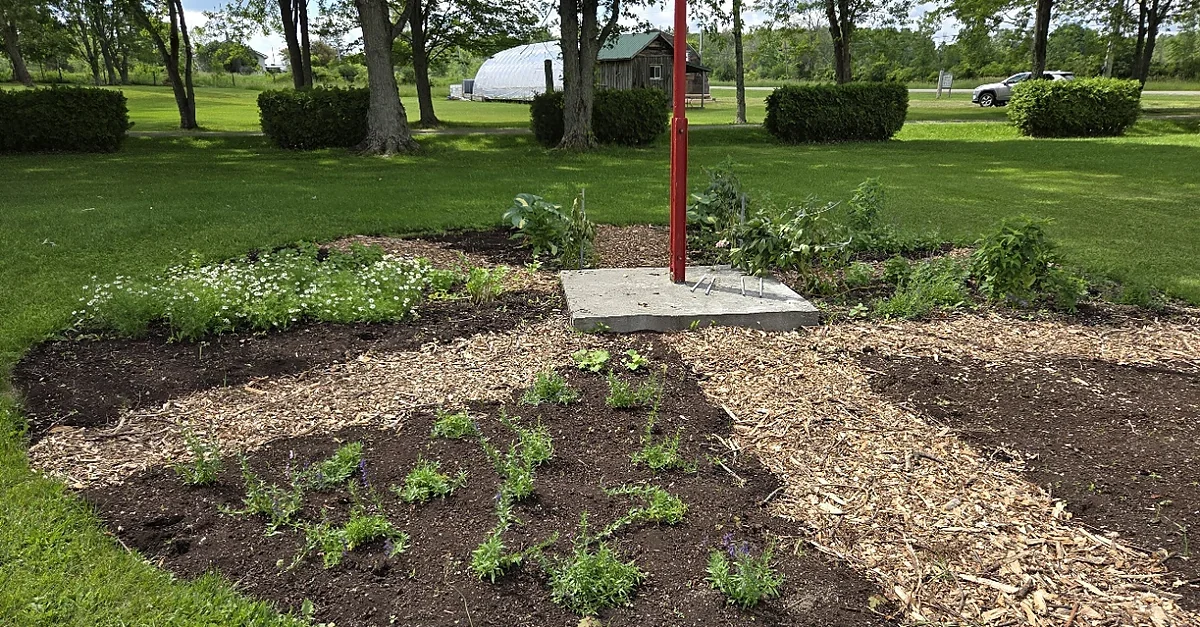
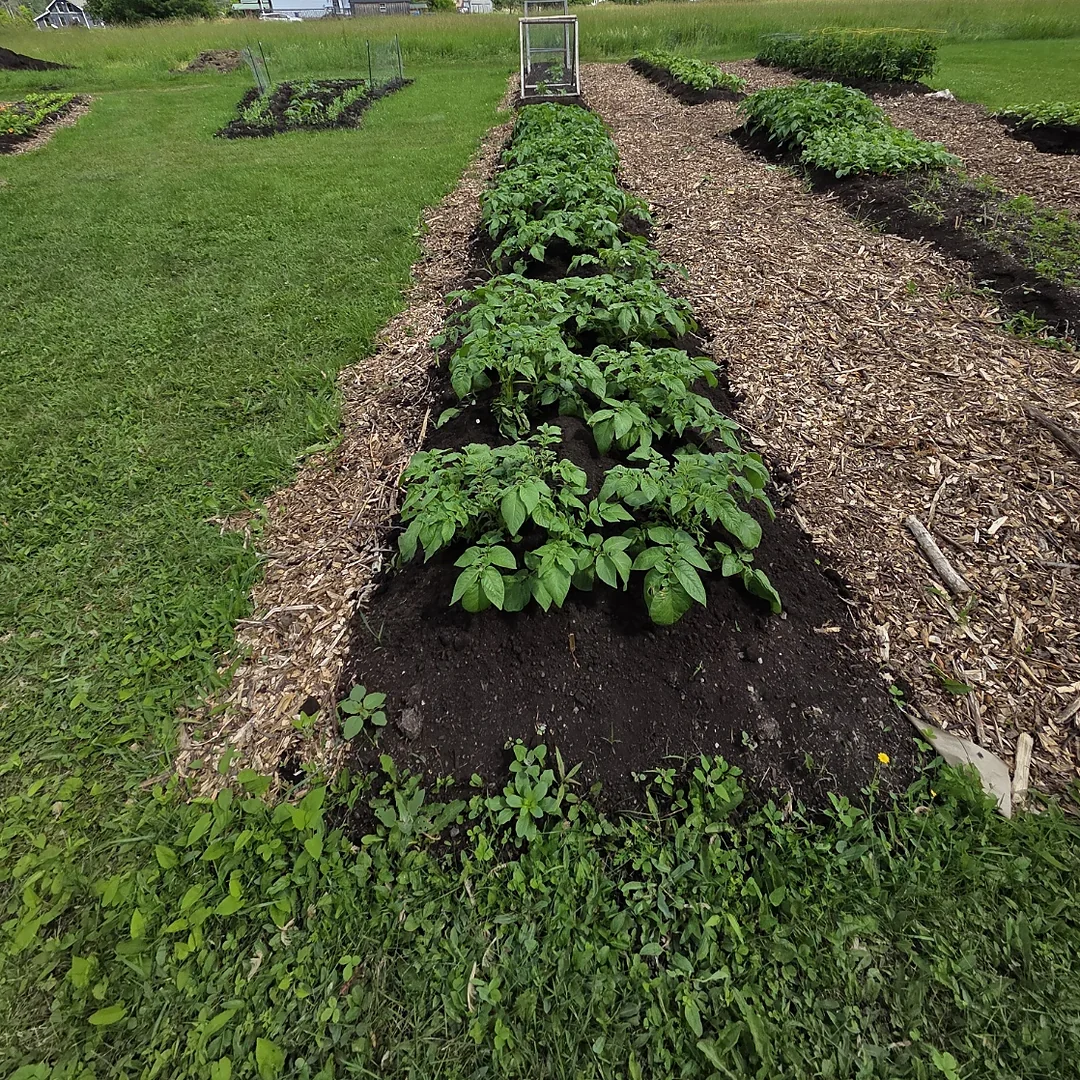
The most visible change so far is the garden beds. We put the bulk of them in over two days. Soil laid on top, wood chips between the rows. We built a big circular bed around the flagpole in the front yard and planted it with herbs and flowers.
The soil underneath all of that is heavy clay. That sounds like a problem. It isn't. Clay holds water, which is exactly what you want in a drought as long as the top layer has some protection. I grew up working gardens with heavy clay. Every kind of land has its trade-offs. Sandy loam drains well but challenges you in dry years. Clay is the opposite and is a challenge in years like this year when its wet but rewards you when it isn't. You add humus on top of the clay: compost, wood chips, organic matter, and it gets better every season.
No spray. Ever. We may not chase organic certification, but we will not be using pesticides or herbicides. Everything is going to be organic in style, working with nature where it makes sense, borrowing from permaculture where it fits, and using market garden methods where those work better.
The quieter work this month is the greenhouse. None of these buildings have been used in over ten years. They're in good shape, but they need to be brought back to life. Ventilation. Beds. Water totes for irrigation that aren't hooked up yet. That's a several-month project, not a weekend one.
The Current Vision
Medley Micro has been a microgreens business for a couple of years. The farm lets us be more than that. I expect our vision will adjust over time, as it should while we learn about the natural rhythms of the property, but here is what we are envisioning at this time.
Microgreens will live in one of the structures where we can control the temperature and humidity properly. They need that kind of environment.
Mushrooms will go into a separate, purpose-built room. Mushrooms are fungi, and you don't want stray spores or molds from anywhere else getting into your food crop. We'll likely build that space from scratch later this year.
Market garden vegetables, herbs, and cut flowers in the beds and the greenhouse, with the roadside farm stand pulling it all together.
The small barn becomes a workshop. The other little outbuilding gets used for tools, winter storage, and maybe chickens one day. Still under debate.
The hay field keeps being a hay field. About 20-plus acres of it stays in production for our neighbour. We'll cut walking paths around the edges, maybe lay wood chips so we don't have to keep mowing them.
The natural areas remain natural and we protect those areas as land stewards.
We work with the broader community in our endeavours. Although we have some ideas for this, we haven’t settled on exactly this looks like other than continuing to support Loaves and Fishes.
Down the road, probably a year or two out, a gazebo or pavilion for farm-to-table dinners with a local caterer, community gatherings, maybe a yoga night now and then. And a screened gazebo back toward the lake for evenings.
The goal is a micro farm that pays its own way and generates enough to fund the infrastructure projects as we go. Not a corporate farm. Not a hobby that bleeds money. Something in between that gets a little better every year and gets passed on in better shape than we found it.
A Few Things I Want You to Take Away
If you're reading this and turning something similar over in your own head, three things:
You're never too old to start something new. We are close to traditional retirement age and we are just getting going.
You don't need a lot of land to grow your own food. We bought 30 acres because that's what came up, but you can do a remarkable amount on a quarter acre, a balcony, or the corner of a backyard.
This is a lifestyle, not a job. It's physically demanding. Microgreens need attention seven days a week. You can't plant them and walk away for ten days. If you're going to do this, do it because you want this life. Otherwise it will grind you down.
A year from now I'd like to be sitting on the deck looking out and seeing the greenhouse dialled in, a small mushroom operation running, microgreens humming along, and fruit trees and berry bushes in the ground. Probably not bearing yet. That's fine. A little bit every year.
Come Say Hi
If you're local, stop by the farm stand located between Mallorytown and Athens in McIntosh Mills (or come find our products at the local stores and cafe). Try the microgreens if you haven't. You can order at medleymicro.ca.
If you want to follow along as the farm comes together, the greenhouse rebuild, the first mushrooms, the fruit trees going in, what we learn the hard way, sign up for the newsletter. We'll send the good stuff and skip the noise.
We're glad to have you along for the ride.
Robert
Disclaimer: This article and the associated website do not provide medical or nutritional advice. The information and material contained on this website are for informational and/or entertainment purposes only. No material on this site is a substitute for professional medical advice, diagnosis, or treatment.
Always seek your physicians' or qualified nutritionists' advice before undertaking a new healthcare regimen or using any information you have read on this website to treat or prevent any condition.