
Sprouts vs. Microgreens: What's the Difference and Which One Belongs in Your Spring Reset?
You've probably seen both at the grocery store or the farmers market. They look similar, they're often shelved near each other, and people use the terms interchangeably. But sprouts and microgreens are genuinely different things: how they're grown, what they taste like, and what they do for your body.
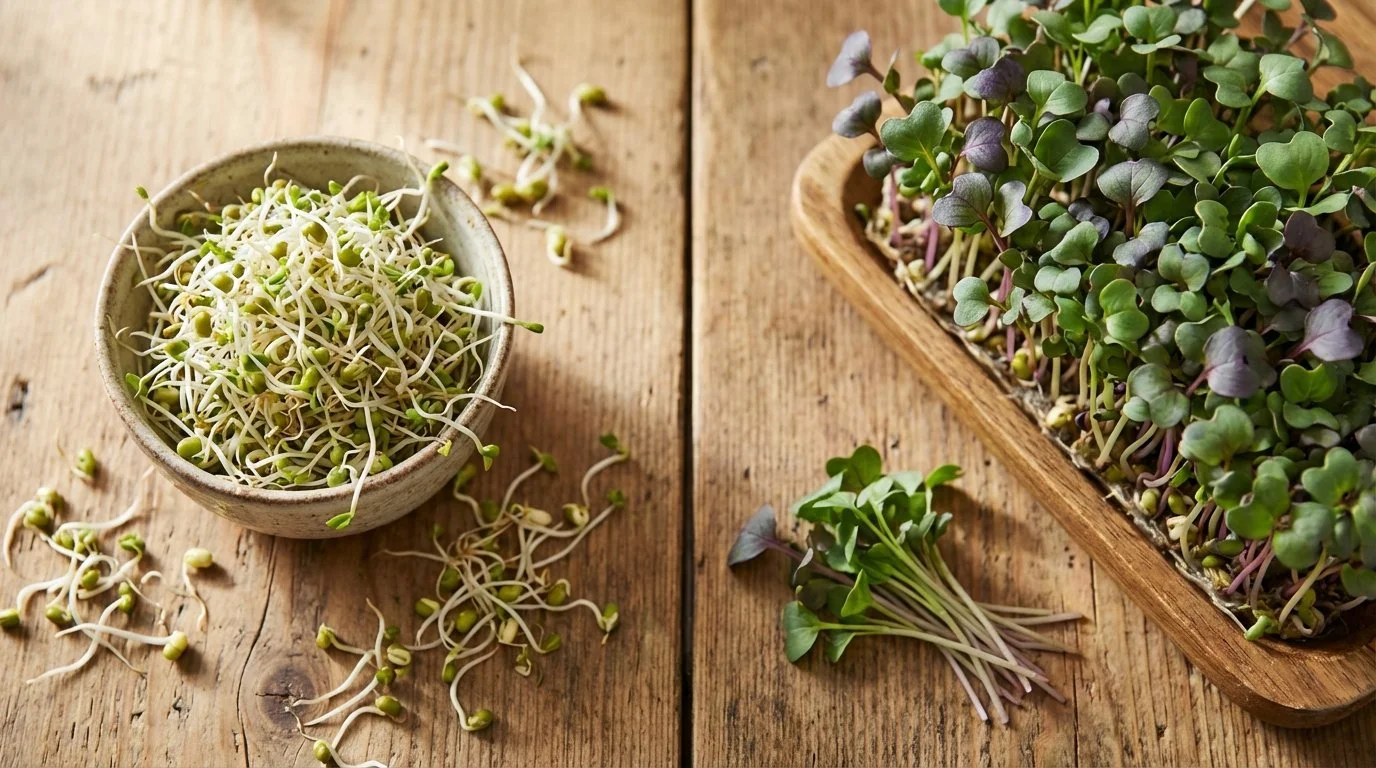
Spring is the season when people start paying more attention to what they eat. And if you're trying to add more fresh, nutrient-dense food to your plate this April, it's worth knowing the difference, because it changes which one makes sense for you.
Let's break it down.
What Are Sprouts?
Sprouts are seeds that have just begun to germinate. The whole sprouted seed (hull, root, and shoot) is eaten together, usually after just 3 to 7 days of soaking and rinsing in water.
No soil. No growing medium. Just seeds and water.
Common sprout varieties include alfalfa, mung bean, lentil, radish, and broccoli. You've likely seen them piled into a sandwich at a café or sitting in a clear container in the produce section.
How they're grown at home: A mason jar with a mesh lid is the classic method. Soak, drain, rinse twice a day, and in less than a week you have sprouts. The barrier to entry is extremely low.
What Are Microgreens?
Microgreens are the same seeds taken one step further. Instead of eating the germinated seed immediately, you plant it in soil or a growing medium and let it grow until the first true leaves appear, usually 7 to 21 days depending on the variety.
Only the stem and leaves are harvested. The roots and seed stay in the growing medium.
At Medley Micro Farm, we grow broccoli, sunflower, radish, arugula, kale, pea, oriental mustard, and yellow mustard microgreens right here in Eastern Ontario using organic-style methods. Each variety has its own distinct flavour profile and nutritional story.
How they're grown: In a shallow tray with a growing medium, placed near a light source. More involved than sprouts, but still very manageable, and the results are noticeably different.
How Do They Compare Nutritionally?
Both sprouts and microgreens are more nutrient-dense than their mature counterparts. But the comparison between them is more nuanced than most people realize.
Microgreens: Concentrated Nutrition
A widely cited USDA-funded study found that microgreens can contain up to 40 times more nutrients than the same plant at full maturity. That includes vitamins C, E, and K, along with beta-carotene and lutein, depending on the variety.
Broccoli microgreens in particular are exceptional, containing up to 100 times more sulforaphane than mature broccoli. Sulforaphane has been linked in research to anti-inflammatory effects, cardiovascular support, and cancer prevention.
Microgreens are harvested at a point when the plant's energy is almost entirely concentrated in its leaves and stem, which is part of what makes the nutritional density so high.
Sprouts: Enzymatic Activity and Digestibility
Sprouts have their own nutritional strengths. The germination process activates enzymes that break down anti-nutrients like phytic acid, which can make the nutrients in seeds and legumes easier for your body to absorb. Sprouted grains and legumes are easier to digest for many people as a result.
Sprouts are also a decent source of protein, fibre, and certain B vitamins, particularly folate.
The Honest Comparison
For raw nutritional density (especially vitamins, antioxidants, and plant compounds like sulforaphane and glucosinolates), microgreens generally win. For digestibility and enzymatic support, sprouts have a legitimate edge.
They're not really competing. They're doing different things.
What About Food Safety?
This is the part that often gets left out of the conversation. And it matters.
Sprouts are grown in warm, wet conditions with no airflow and no soil. Those are ideal conditions for bacterial growth, including E. coli and Salmonella. Health Canada and the CDC have both issued guidance about sprout safety, particularly for pregnant women, young children, older adults, and people with compromised immune systems. The risk isn't theoretical: sprout-related outbreaks do occur.
This doesn't mean sprouts aren't safe to eat. It means the growing conditions require extra care, and certain people should be cautious.
Microgreens are lower risk. They're grown in a growing medium, harvested above the soil line, and typically have better airflow. The conditions that make sprouts vulnerable (constant moisture, no drainage, no air circulation) simply aren't part of how microgreens are grown.
For most people, this won't be the deciding factor. But it's worth knowing, especially if you're feeding young kids or elderly family members.
Flavour: Night and Day
This might be the most practical difference of all.
Sprouts are mild and slightly beany, with a satisfying crunch. Alfalfa sprouts have almost no flavour on their own; they add texture more than taste. Mung bean sprouts have a bit more presence, which is why they're such a staple in Asian cooking.
Microgreens have genuinely complex, distinct flavours that vary significantly by variety:
Broccoli microgreens: Mild with a subtle peppery finish. Approachable and versatile.
Arugula microgreens: Bold, peppery, and nutty. Like a more intense version of mature arugula.
Oriental mustard microgreens: Sharp and spicy with a wasabi-like kick. For people who want real heat.
Yellow mustard microgreens: Mild and zippy. The everyday spice option.
If flavour matters to you (and it should, because flavour is what makes healthy food sustainable), microgreens offer something that sprouts simply can't match.
So Which One Belongs in Your Spring Reset?
If you're looking to add something fresh, nutritious, and genuinely flavourful to your spring cooking, microgreens are the clearer choice.
They're more nutrient-dense, lower risk, and the flavour variety means you can use them across a much wider range of meals. They're not a garnish. They're an ingredient.
That said, if you're interested in the enzymatic benefits of sprouting, or you want a zero-equipment way to grow something fresh at home, sprouts are a legitimate option worth exploring.
But for your Spring Reset? Start with microgreens. Pick one variety. Add it to one meal you already make this week. That's the reset.
Download our free Microgreens Recipe Ebook and get practical, flavour-forward recipes that make it easy to use microgreens every day this spring.
References
Xiao Z, Lester GE, Luo Y, Wang Q. Assessment of vitamin and carotenoid concentrations of emerging food products: edible microgreens. Journal of Agricultural and Food Chemistry. 2012;60(31):7644–7651. https://pubs.acs.org/doi/10.1021/jf300459b
Fahey JW, Zhang Y, Talalay P. Broccoli sprouts: an exceptionally rich source of inducers of enzymes that protect against chemical carcinogens. Proceedings of the National Academy of Sciences. 1997;94(19):10367–10372. https://www.pnas.org/doi/10.1073/pnas.94.19.10367
Bai Y, et al. Sulforaphane Protects against Cardiovascular Disease via Nrf2 Activation. Oxidative Medicine and Cellular Longevity. 2015. https://pmc.ncbi.nlm.nih.gov/articles/PMC4637098/
Health Canada. Sprouts and food safety. Government of Canada. https://www.canada.ca/en/health-canada/services/food-safety-fruits-vegetables/sprouts.html
Taormina PJ, Beuchat LR, Slutsker L. Infections associated with eating seed sprouts: an international concern. Emerging Infectious Diseases (CDC). 1999;5(5):626–634. https://wwwnc.cdc.gov/eid/article/5/5/99-0503_article